GTIN vs SSCC: What Food Brands Need to Know
What you can do on this page
- Read the short answer just below.
- Use the free tool to count the barcodes you need.
- Ask for a free one-page shelf plan for your own food. A person writes it.
Short answer
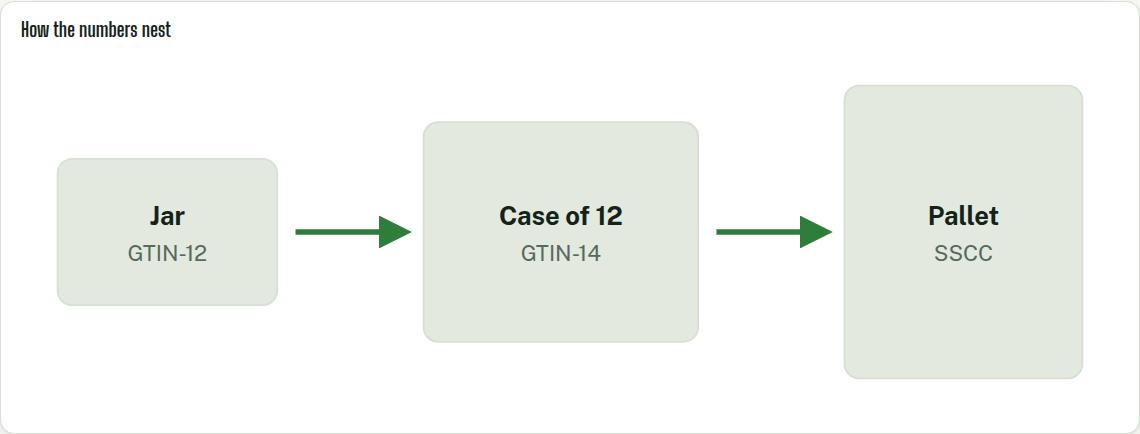
A GTIN identifies a product; an SSCC identifies a shipping unit. Many retailers and distributors ask for both, and they serve different parts of the supply chain.
From recipe to retail-ready barcode
- Get a prefixApply to GS1 US for a company prefix
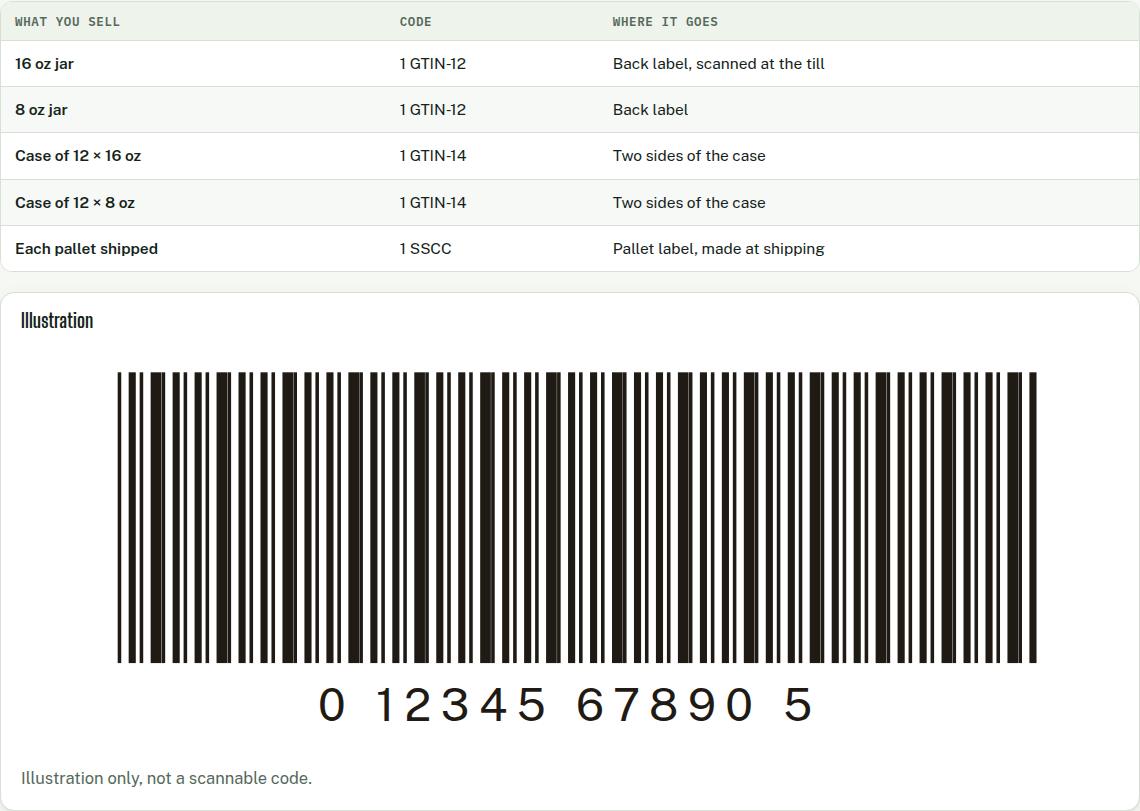
- Number each itemOne GTIN per product, size, flavour
- Label each palletOne SSCC per shipping unit
- Test the scanCheck print quality before the first order
How many numbers do you need?
A planning count, not a GS1 rule. Ask your retailers which pack levels they scan, and pick a GS1 US prefix with room to grow.
In our product
What you get, as our customers see it.
Real screens from our reports and dashboard, made for a made-up brand. Click any one to open the full sample.
What a GTIN (product barcode) is
A GTIN (Global Trade Item Number) is the numeric identifier that appears in the UPC, EAN or ISBN barcode on a product package. It uniquely identifies the product itself, regardless of where it is shipped.
What an SSCC (shipping barcode) is
An SSCC (Serial Shipping Container Code) is a unique number assigned to a logistic unit – a pallet, case or container – that moves through the supply chain. It is printed as a GS1‑128 or 2‑D barcode on the shipping label.
Getting GTINs and SSCCs from GS1 US
Companies apply for a GS1 US prefix. Once you have a prefix you can generate GTIN‑12/13/14 numbers for each product. For SSCCs you use the same prefix plus a serial reference for each container. GS1 US provides an online portal to manage both numbers.
GS1 US Sunrise 2027: getting ready for 2‑D barcodes
Sunrise 2027 is an industry goal set by GS1 US: retail checkout scanners should be able to read 2‑D barcodes, such as a GS1 DataMatrix or a QR code with GS1 Digital Link, by the end of 2027. It is a readiness target, not a rule that replaces the UPC. The same GTIN works in either symbol, and many brands will print both during the change.
SKU checklist
- Confirm you have a GS1 US company prefix.
- Assign a unique GTIN to each product variation.
- Create an SSCC for each shipping container.
- Ask your retailers when they plan to scan 2‑D barcodes, and plan any label change with them.
- Verify barcode quality with a GS1‑approved scanner.
Barcodes done? Get the shelf plan next.
Buyers check the barcode, the price and the case pack. We help with all three.
Questions makers ask
What is the difference between a GTIN and an SSCC?
A GTIN identifies a product. An SSCC identifies one shipping unit, such as a pallet or case, on its way through the supply chain.
Do I need a new GTIN for each size and flavour?
Yes. Each product variation gets its own unique GTIN.
Does Sunrise 2027 replace the UPC?
No. It is a GS1 US readiness goal for checkout scanners to read 2-D barcodes by the end of 2027. The same GTIN works in either symbol.
Sources
https://www.gs1us.org/upcs-barcodes-prefixes
https://www.gs1us.org/upcs-barcodes-prefixes/get-started-guide
https://www.gs1.org/standards/id-keys/sscc
https://www.gs1us.org/industries-and-insights/by-topic/sunrise-2027
Book a demo