Learn
Guides, four chapters and stories from the data.
In our product
What you get, as our customers see it.
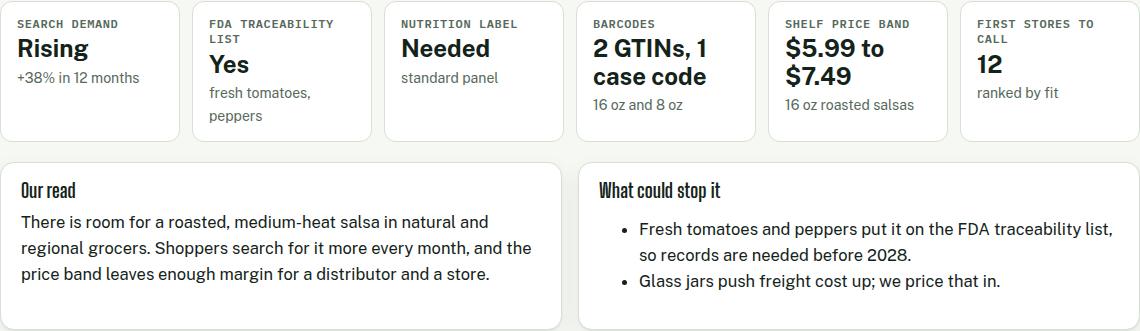
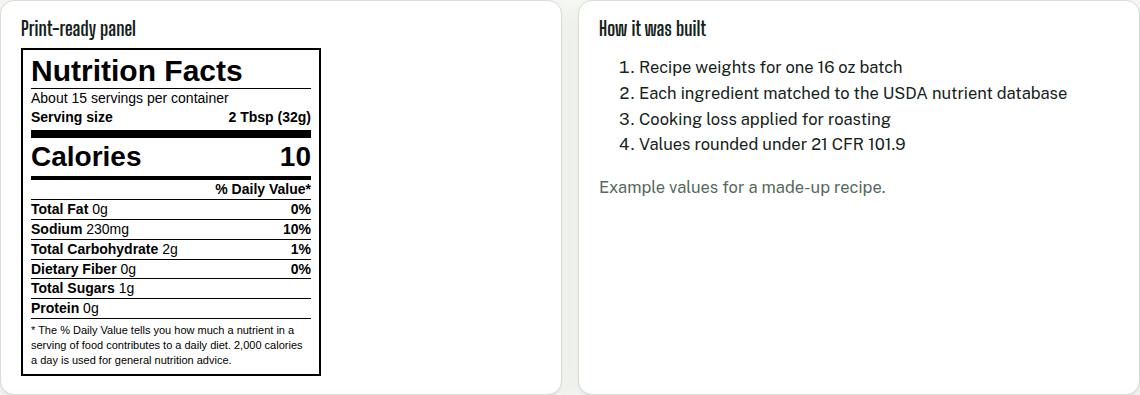
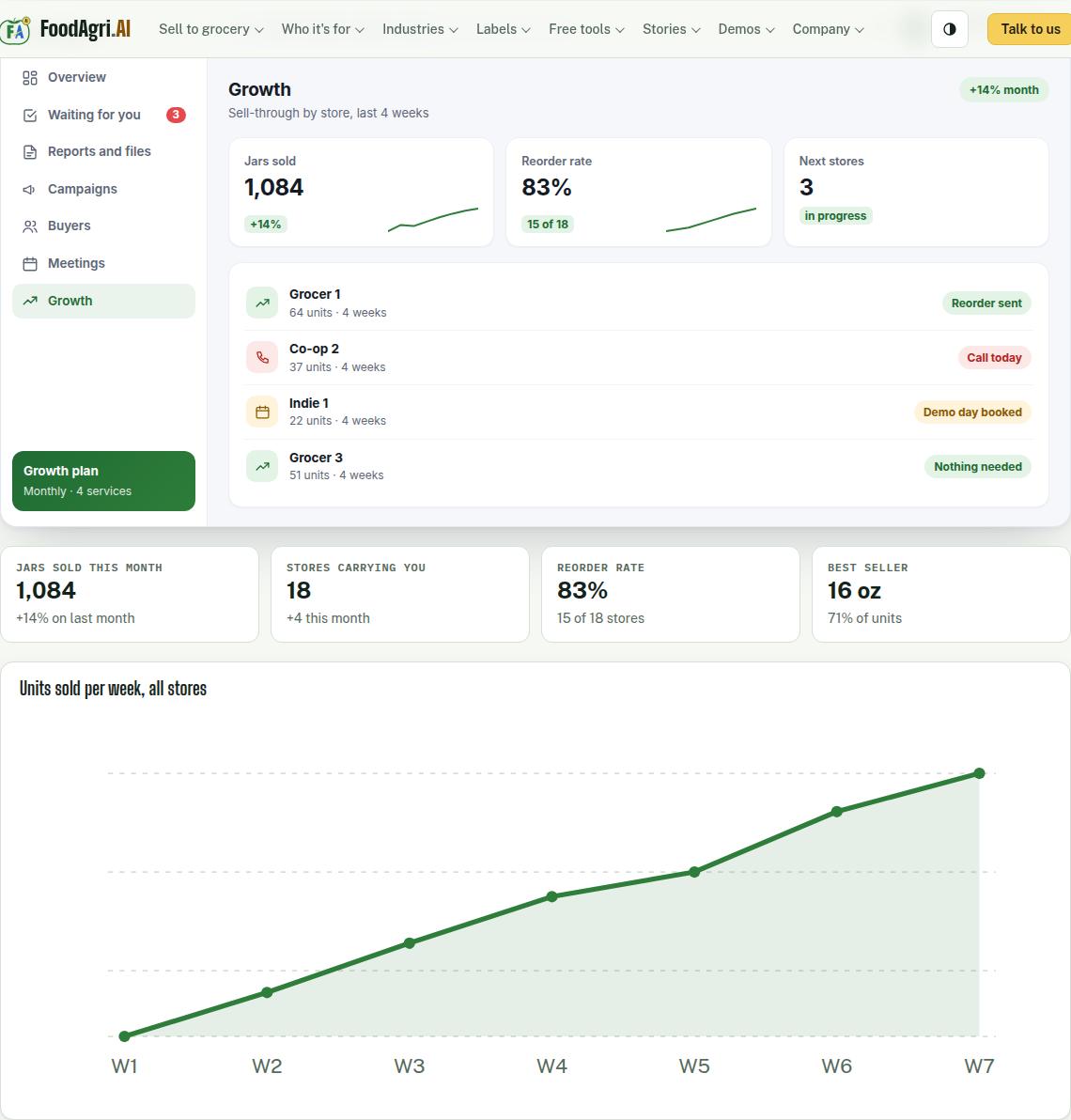
Real screens from our reports and dashboard, made for a made-up brand. Click any one to open the full sample.
What food makers ask right now
Start with your question. We give the answer first.
These are the food-business topics people search for most in the US, and the exact questions they type. Pick one: you get a free tool or guide for it, and it shows the path we would take you on.
Monthly searches: national US search-volume data, measured October 2026. Questions: the phrases search engines suggest as people type, collected October 2026. Topics marked "asked often" had no measured volume yet.
Start where other food makers start.
These are the questions food makers type into search every month in the US. Each one has a page here that answers it, with a tool you can use.
Most makers start with the label: a recipe nutrition calculator. If you do not have a label yet, start there. If you do, the next big questions are finding buyers and barcodes.
US monthly searches from national search-volume data, October 2026. Click a topic to see what it means.
We read the rules and the reports. You get the story.
Each story takes one rule, report or data set, explains it in plain words, and ends with what to do next. Everything stays on this site.
Story · money
Where a $6.92 jar's money goes
A jar of salsa sells for $6.92. The maker sees $1.20 of it.
Follow one made-up jar from the kitchen to the shelf. It costs $2.40 to make: ingredients, jar, label, labour and delivery. The maker sells it to a distributor for $3.60. The distributor adds 25% and sells it to the store for $4.50. The store keeps a 35% margin, so the shopper pays $6.92.
That leaves the maker $1.20 a jar, before marketing, slotting fees or a bad batch. If a broker sells it into the stores, their commission usually comes out of the maker's share too: about 3 to 5% in conventional grocery and 8 to 12% in natural stores. At 5% of $3.60, that is another $0.18 a jar.
What to do next: set your price backwards from the shelf, not forwards from your cost.
Work your own numbers back from the shelf →Story · labels
Why the label says 45 when the lab says 47
Nobody made a mistake. The rule tells you to round.
Your lab sheet says a serving has 47 calories. Your Nutrition Facts label says 45. That is the rule working.
Federal labelling rules say calories are shown to the nearest 5 up to and including 50, to the nearest 10 above 50, and amounts under 5 may be shown as zero (21 CFR 101.9(c)(1)). So 47 prints as 45, 53 prints as 50, and 3 can print as 0.
Fat, sodium, sugars and the other lines each have their own steps. Rounding is where many hand-made labels go wrong.
Check every line of your label →Story · dates
The dates on every food maker's wall
The dates that come round whether you are ready or not.
- FDA food facility registration. Register before you start, then renew every other year between October 1 and December 31 of each even-numbered year. 2026 is one of those years (21 CFR 1.230).
- Food safety plan. Where the preventive controls rule covers you, reanalyze the plan at least once every 3 years, and sooner after a big change (21 CFR 117.170).
- FSMA 204 traceability. The FDA proposed moving the compliance date to July 20, 2028, and Congress directed the FDA not to enforce it before then. See if your food is on the list.
- GS1 Sunrise 2027. An industry goal: checkout scanners should read 2-D barcodes by the end of 2027. The UPC stays. What it means for your codes.
What to do next: put the dates that apply to you in one calendar, with a reminder a month ahead.
Get the paperwork in order →Story · buyers
How a buyer list gets built
From everyone who could buy, to the few worth a first message.
A good buyer list starts wide and gets narrow on purpose.
- Start wide. Every store, chain and distributor that sells your category in the regions you can ship to.
- Keep the ones that fit. Store format, shelf, price band and the products they already carry.
- Find the right person. The category buyer, not the general inbox. Check the role and the address.
- A person reviews it. Before anything goes out, someone reads every row.
- You approve the first wave. Nothing is sent without your yes.
Get clear before the expensive commitments
A 30-minute call tells you what you need next and what you would receive. The same four steps for every path, and you decide at the end of each one whether to go on.
- Step 1A 30-minute call
You tell us what you make and what you need. No slides. We say plainly if we are not the right fit.
- Step 2Quick research
A short brief: who buys, what the rules say, where the price room is, and the sources behind each answer.
- Step 3Plan and build
The pages, videos, reports and outreach drafts the plan needs, in your brand.
- Step 4Launch and measure
You approve every send and post. We report what worked and change what did not.